What training do professionals need to start using AI in their company? Six recommendations
Artificial intelligence is a crucial tool for companies to grow and stay ahead of the competition, but a recent survey among employees of Flemish SMEs (2-100 FTE) showed that barely 23% have already taken the step to AI. For 33%, AI is still being researched, while 35% are simply not interested in it. How can we make Flemish SMEs enthusiastic about AI innovation? Based on the answers of the professionals and our own experience with AI training, we formulated 6 recommendations for organizing targeted AI courses.
1. Recognizable, practical examples
SMEs need tangible examples: How can AI improve their business operations? Training courses must therefore draw on concrete practical examples that are relevant to the type of SME to which the training course is aimed. By showing how AI has been successfully applied in similar business environments, SME leaders can better imagine the potential benefits for their own businesses. Examples from large high-tech companies are therefore often not suitable for smaller Flemish SMEs.
- Do: an example of AI implementation in an ice cream cart for the food industry.
- Don't: fragment of automation at a mega company like Coca-Cola for the Flemish food industry.
2. Accessible language
Employees in SMEs are primarily interested in solving problems in their work, not in integrating the latest technology. And they very often work in Dutch . Therefore, the technical and often English jargon of most AI courses can be intimidating for non-technical SME leaders. Successful training courses explain AI concepts and terminology in understandable language. They avoid complex technical terms and limit the amount of English. This allows the courses to appeal to a broader audience and lower the barrier to AI adoption.
This difference is immediately apparent in course titles alone. These are two possible titles for the same course:
3. Financial insights
One of the most important considerations for SMEs when deciding whether to embrace AI is the financial implications. SMEs find it very difficult to gain insight into this. Enterprise-oriented training courses should therefore include educational modules that help calculate the costs and benefits of AI implementation. By providing insights into investment requirements and potential returns, training can help SMEs make informed decisions about their AI strategy.
- Do: a practice-oriented training on the concrete implementation of AI.
- Don't: a training course that shows all technical possibilities, but does not provide information about implementation.

AI adoption in Flanders
We asked this question to 470 professionals who work at an SME with 2 to 100 full-time employees and who have decision-making rights in their company, located in Flanders: Is AI technology used in your SME/the SME where you work? AI is software in which a computer model is trained using its own and/or external data to perform certain specific (routine) tasks without explicit programming. AI is not: the use of online AI tools such as ChatGPT, Midjourney, AdobeSensei, Grammarly, ...
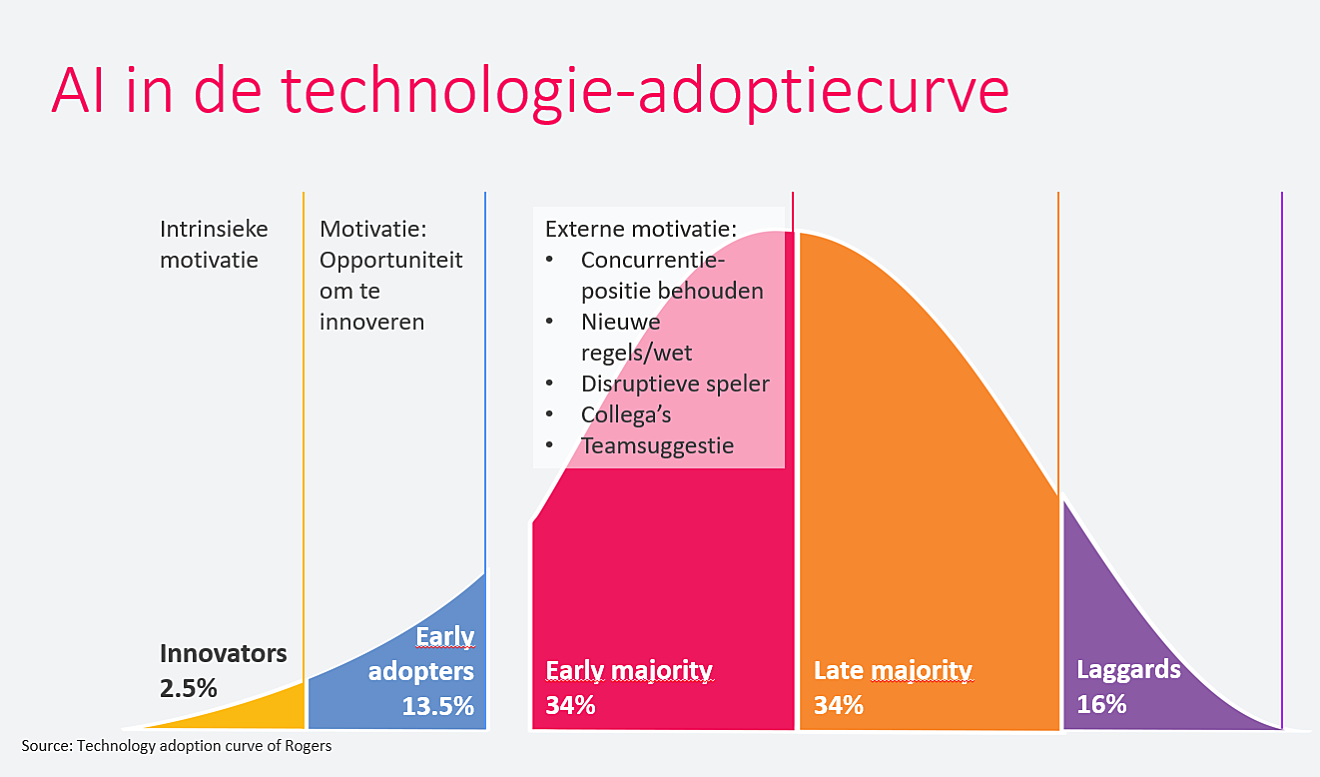
AI-adoptie in Vlaanderen
According to Moore / Rogers' AI adoption curve, AI in Flanders is situated right in the innovation gap: only when this gap has been bridged, will the breakthrough of this innovation be certain. As an open economy, Flanders has no choice in this: internationally this technology is already becoming mainstream. Since breakthrough is not the issue, the question is how we can motivate the early majority in Flanders to start using AI.
- Innovators start with new technology because they want to do so "of their own accord": they want to innovate.
- The early majority then waits until motivation comes from outside the company: competition increases the pressure, new rules or legislation, a disruptive player. Other reasons, not entirely extrinsic, are requests from the team. This group typically waits until the technology is reliable and free of teething pains.
In other words, people who are not yet (actively) interested in AI must be addressed differently: they are not interested in the technology itself, they want insight into the concrete solutions offered by the technology.
4. Personalization of training programs
Every SME is unique, with different AI adoption needs and challenges. It is therefore important that training courses are flexible and offer different learning paths tailored to the specific characteristics of the target group. By offering personalized training pathways, SMEs can acquire the knowledge and skills most relevant to their situation. So don't start from the content that may be the same for different target groups, but start from the target group.
- Do: training in many small modules, aimed at specific target groups
- Don't: organize the same training on AI in healthcare for pharmacists and nurses together

5. The IT manager as the driver to introduce AI in SMEs
The IT manager of an SME plays a key role in guiding AI adoption in companies. SMEs that outsource their IT were 12% more likely to say they had no interest at all in AI. IT managers are in the driver's seat to explain the benefits of AI to their companies, but of course, they need to have the necessary knowledge. And that involves much more than just technical knowledge, it also contains data and process management, ethics...
- Do: more training for IT managers, touching on business processes, ethics, data management, costs, company advantages...
- Don't: purely technical training where the IT department is isolated from the company
6. The AI ambassador as a driving force
In addition, there is a need for more AI ambassadors in Flanders. These profiles have in-depth knowledge of both data & AI and business processes. By offering specific training for these professional profiles, more SMEs can appoint an AI ambassador to effectively install AI in their organization. Also, the competition for these profiles will become less cutthroat.
- Do: more training for AI ambassadors
- Don't: courses that approach either the IT side or management side of AI. We need people who can function as bridges between both departments.
Successfully embracing AI in Flemish SMEs is not just a matter of technical implementation. It also requires cultivating an atmosphere of innovation and lifelong learning. By taking these recommendations to heart, training courses can reach more professionals and ultimately more Flemish SMEs will strengthen their competitive position. For Flemish professionals, data management and AI will from now on be self-evident!
And now?
- Discover all the answers to our survey on AI training needs among Flemish SMEs
- Would you like to learn more about this study and about innovation in companies? Then definitely come to SERV-Academy: From AI to Z.
- Would you like to learn more about how VAIA & partners want to achieve a mAIndshift? Also read "The numerous paths to a mAIndshift in Flanders".
- Do you want to start with AI in your company? Then discover Start AI or consult VLAIO.
Isabelle Borremans
Isabelle is not an AI expert, but she has been communicating about AI (and AI training) for VAIA for four years. So, she knows exactly how to communicate effectively about AI training. Feel free to contact her with any questions on how to promote your AI course. She’ll gladly challenge you with questions like:
- Who is your target audience? Can you be more specific?
- What networks reach that audience?
- Where does your audience prefer to take courses?
- What AI skills does your audience need?
- Does your training match their needs?
Besides communication, Isabelle also works on VAIA’s strategy: Who is our audience? How can we reach them? How can we spark their interest in AI?
