Current Trends in AI
Practical information:
Georganiseerd door:

Program
Agentic AI: How can multi-agent systems benefit your business? (Thursday, 29 January 2026)
This session is designed for businesses interested in discovering how multi-agent systems can enhance their operations. Are you curious about AI agents and how they collaborate to solve complex problems? Join us to explore the fundamentals, recent research developments, and real-world applications of these systems.
This session provides a historical overview of the development of agents and multi-agent systems, tracing their evolution from early conceptual models to their current role in complex, distributed AI applications. We begin with the foundational ideas of autonomous agents in the 1980s and 1990s, including seminal contributions in reactive and deliberative architectures. The emergence of multi-agent systems is discussed in the context of coordination, negotiation, and cooperation among agents, influenced by theories from economics, game theory, and cognitive science. We conclude with some use cases of what is today referred to as Agentic AI.
Professor Ann Nowé
Semantic Reasoning (Thursday, 19 February 2026)
In this session, we'll explore how semantic reasoning and knowledge graphs can add value to your data and processes. Knowledge graphs offer a powerful way to model complex relationships in your domain, while reasoning allows you to derive new insights automatically by interpreting your domain knowledge. Through concrete examples, we’ll show how these technologies can help you make smarter decisions, improve data integration, and unlock hidden value. We'll discuss how these technologies support interoperability and seamless data integration, making it easier to connect systems, share information, and build solutions that truly understand your domain.
Professor Pieter Bonte
Monitoring of rotating machinery with AI (Thursday, 19 March 2026)
Condition monitoring of rotating machinery, including fault detection, fault diagnosis and estimation of Remaining Useful Life (RUL), offers significant cost benefits to industry by minimizing unexpected downtimes and failures. Data-driven approaches, often based on Deep Learning, have achieved significant performance. However, limited data availability for model training, influence of varying operating conditions, lack of interpretability and need for robustness and reliability in predictions pose significant challenges in the application of AI based models in real-world applications. The goal of this talk is to present a methodology for diagnostics and prognostics under varying operating conditions, based on Digital Twins and Transfer Learning, which mitigates the need for large historical data for model training, estimating and quantifying in parallel the epistemic and aleatoric uncertainty of predictions, addressing the safety issues in RUL prediction. Moreover a domain transformation technique, which in combination with existing gradient-based XAI algorithms enables the explanation in a domain, different from the input domain of the machine learning model, will be introduced. The methodologies will be applied on different use cases from rotating machinery, with emphasis in rolling element bearings, and their performance will be discussed.
Professor Konstantinos Gryllias
Fairness in LLMs (Thursday, 23 April 2026)
This talk will explore how biases in AI language models can lead to unfair outcomes in real-world applications. We will examine methods for measuring and mitigating these biases, particularly across different languages. We will also address broader safety concerns and technical approaches to creating more fair and responsible AI systems.
Dr. Pieter Delobelle
Teachers / speakers
Professor Ann Nowé is a leading Belgian computer scientist specialised in artificial intelligence, with a focus on reinforcement learning, multi-agent systems, and explainable AI. She is a full professor at the Vrije Universiteit Brussel (VUB), holding joint appointments in the Faculty of Sciences and the Faculty of Engineering. Additionally, she is the head of the VUB Artificial Intelligence Lab, an EurAI fellow, and actively involved in Agent Community (IFAAMAS).

Professor Pieter Bonte is an assistant professor at KU Leuven, campus Kulak, specialising in the efficient processing of Internet of Things (IoT) data using various branches of Artificial Intelligence (AI). His research primarily focuses on Knowledge Representation and Reasoning, with core expertise in semantic reasoning and knowledge graphs.
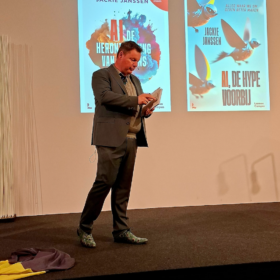
Professor Konstantinos Gryllias is a mechanical engineering professor at KU Leuven, specialising in AI-based condition monitoring of rotating machinery. His research focuses on fault detection, diagnostics, and digital twins, combining signal processing, machine learning, and hybrid modelling. He leads projects in sectors such as manufacturing, energy, and transportation, and is affiliated with Leuven.AI and Flanders Make.
Skills and Expertise: Classification, Unsupervised Learning, Pattern Recognition, Machine Learning, Feature Extraction, Signal Processing, Structural Dynamics, Finite Element Analysis, Stress Analysis, Finite Element Modeling

Pieter Delobelle is currently an AI engineer at Aleph Alpha focussing on inference, alignment and fairness of large language models. Previously, he was a postdoctoral researcher at KU Leuven with a specialization in bias and fairness in large language models and he also developed the state-of-the-art Dutch language model RobBERT. He obtained a Masters in Engineering Technology from KU Leuven in 2018 at the Ghent Technology Campus, Belgium. Subsequently, he obtained an Advanced Masters in Artificial Intelligence from KU Leuven, and he stayed on for a Ph.D. in Computer Science under Professor Bettina Berendt and Professor Luc De Raedt, which he started in 2019 and defended in 2023, titled 'Towards fairer foundation models'. His current research on bias and fairness in large language models led to research visits at Weizenbaum Institute and Bocconi University, as well as an internship at Apple Inc.