A No-Code Approach to Decision Support and Knowledge Capturing
In this workshop, you will get to know the state-of-the-art IDP knowledge-base system, that has been developed at KU Leuven and is currently used by companies in various sectors. You will be able to build basic applications using IDP, and you will be able to identify potential use cases for this technology.
Practical information:
Georganiseerd door:


In their day-to-day operations, companies typically make many small but important decisions, such as:
- which employee should handle an incoming request
- which service should be recommended to a specific customer
- how should a specific product be configured to meet a customer's requirement,
- whether a specific customer is entitled to a discount, etc.
Decision support systems can help employees make these decisions faster, more reliably and more consistently, reducing costs and increasing confidence in the process. To develop such systems, black-box AI methods (such as deep learning) are not well-suited, because they lack the required transparency and explainability. A more promising approach are knowledge-based AI systems, which derive their 'intelligence' not from data, but from logical models of rules, regulations and expert knowledge.
In this workshop, you will get to know the state-of-the-art IDP (Intelligent Document Processing) knowledge-base system, developed at KU Leuven. It is currently being used by companies in the manufacturing, financial and legal sectors to provide various decision support, both to their customers and in-house. This system is based on methods and techniques that were developed for declarative programming systems such as Prolog, but it offers a number of important innovations:
- instead of focusing only on querying, the IDP system provides a wide range of different functionalities that can be used to implement rich interactive interfaces that support users in different work-flows,
- instead of relying on programmers, the system allows its end users to maintain the underlying knowledge base, which means that we can cut out the "middle man" of IT staff and allow the business experts themselves to update the system, thereby not only reducing cost and turn-around time but also putting the ownership of the decision knowledge in the right hands.
The workshop starts with a brief introduction to knowledge-based AI and presents existing applications in the financial and manufacturing sectors. We then proceed with a hands-on tutorial, using a freely available web interface that participants access from their own laptops.
Teacher / speaker
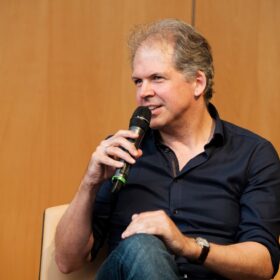
Joost Vennekens
Joost Vennekens is associate professor at the Department of Computer Science and the Faculty of Engineering Technology at KU Leuven (Campus De Nayer, Sint-Katelijne-Waver). His main research area is Knowledge Representation and Reasoning. He researches applications of logic-based AI in finance, manufacturing and law, often in collaboration with Belgian companies.