AI in the library: cataloguing books automatically
Cataloguing collections is a time-consuming and complex task for libraries, but artificial intelligence offers a solution! Hannes Lowagie explains how the Royal Library of Belgium (KBR) is automating this process.

Millions of books, but difficult to find
The Royal Library of Belgium (KBR) collects all contemporary Belgian publications and it has a large historical collection including books, manuscripts, maps and prints. All these publications need to be included in the online catalogue. Until recently, however, many works could not be found there, leaving them invisible to the public. What was needed to solve that? A way to catalogue works quickly and efficiently!
Automatic cataloguing with AI
Training models
KBR therefore developed a tool that uses artificial intelligence to process and validate bibliographic data. They started working with Microsoft Power Platform: it contains ready-made AI models, but you can also use it to train customised models. For example, you can create a new model for document processing by uploading your own files and manually labelling the relevant information first. The AI model then analyses the layout of your files and extracts data from the appropriate fields.
Title pages as a foundation
KBR’s first model was trained on title pages of books. Although each is unique, the model can recognise and process the main types based on the layout. The result? Starting from one simple scan of the title page, they can now automatically describe a book and make it findable
in the online catalogue. This gives the library more insight into its collection and it’s easier for readers find the right book faster.


How do library staff use this tool?
This AI tool is embedded in the daily workflow of KBR staff. They send the titles and back cover texts of books to the AI model, along with a fixed heading list. Based on this input, the model automatically selects the most appropriate heading for each book.
When choosing Microsoft Power Platform, the user experience was paramount. First, the integration with existing applications (such as Windows 365, SharePoint, and OneDrive) ensures that AI is not a stand-alone experiment, but really becomes part of the daily workflow at KBR. This made the threshold for employees low and they immediately see the added value. In addition, the platform allows rapid implementation of adjustments and response to changing needs.
“ Thanks to AI, the library gains more insight into its collection, and it’s easier for readers to find the right book faster. ”
Digitising other files
The team also developed AI models that can process file types other than title pages:
- Colophons: By automatically extracting ISBN numbers, among other things, contemporary books are also registered quicker and error-free.
- Old maps: an automatic description helps digitise these historical sources and make them accessible.
- Catalogue sheets (printed or handwritten): AI processing of scans helps digitise older catalogues and make them searchable.
- Magazines: By automatically assigning keywords to tables of contents, users can find the right information faster.
This broad use of AI allows the library to process new books more efficiently and improve the accessibility and usability of its existing collection. Moreover, it can also be applied in other sectors; in fact, any organisation that wants to digitise paper-based information.
Opportunities and challenges
AI has given library cataloguing a huge boost:
- Where manual work used to be required, technology is now taking over repetitive tasks.
- This allows staff to focus on the more complex aspects of bibliographic work.
But this automation also leads to errors:
- Some title pages deviate significantly from the standard format. Then AI has trouble interpreting them correctly.
- Classification based on text alone is sometimes insufficient: physically viewing a book may be necessary to distinguish a novel from a comic book. (On the other hand: An example of image recognition: detecting comics in the archive)
- Works like My life is a comic! by Maryvonne Rebillard are extra complex: a novel about a boy reading a comic strip. Because the synopsis contains the word ‘comic book’ several times, the work was mislabelled as a comic book.

Library staff and AI, stronger together
The AI integration at KBR shows how technology can help libraries catalogue faster and more efficiently, making their collections even more accessible. But the limitations then again point out that you should always monitor AI output and keep refining the methods, for example by adding extra info to your model.
KBR continues to explore the potential of artificial intelligence for the library sector – always with the conviction that AI is a tool and does not replace human expertise. By using automation to support librarians with profound knowledge, we make Belgium’s rich book collection more accessible than ever!
Find out more!
Create your own app
Want to build your own cataloguing application? This guide will help you get started:
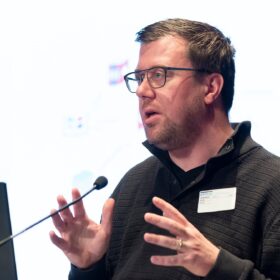
Hannes Lowagie
Hannes Lowagie obtained a PhD in history from Ghent University in 2012. Since then, he has worked at the Royal Library of Belgium (KBR): the national library that preserves and researches millions of heritage items. He researched medieval coins, worked in the digitisation department, and then took charge of the implementation of a new library management system.
Today, he is head of the Agency for Bibliographic Information. There, he is responsible for the catalographic processing of all incoming publications. The aim is to present the information on these documents in the most structured and correct way possible, so that users quickly find what they are looking for. In this context, he is constantly looking for ways to make processing more efficient. He investigates how artificial intelligence can be used in work processes, both for describing and unlocking historical documents and recent publications.
Related courses

SAIAR Summer Studio: From latent to physical space
Zomerschool - Kortrijk - Howest Hogeschool, SAIARlab

HPC Café
Seminarie - Online, Karlsruhe - KIT, HammerHAI, Training geselecteerd in de Belgische AI Factory Antenna (AIFA)
