Edge Intelligence Unleashed: Mastering Embedded AI for Industry Advancement
In this three-day summer school, you’ll learn how to apply machine and deep learning at the device level. The summer school will cover the key hardware, software frameworks, and techniques for optimizing network architectures in edge processing.
Through expert guidance and hands-on practice, you’ll build a strong foundation in embedded AI and gain practical tools to apply directly to your own work context and business case.
Praktische info:
Leertraject
Inschrijven?
- Inschrijvingen: tot 08 sep. 2025
- Voorwaarden: Basic notions of data structures and algorithms, signal processing, convolutional neural networks and languages C++, Python & Linux (command line instructions) are needed to follow the programme adequately.
- Prijs: 1200
georganiseerd door:


Learning goals
- Gain a comprehensive understanding of machine and deep learning and their applications in embedded systems.
- Learn about the necessary components and frameworks for edge processing and how to optimise network architectures.
- Understand the hardware and software required for embedded AI, and the different techniques available for optimising embedded machine learning algorithms.
- Develop practical skills using tools such as Edge Impulse and TensorFlow Lite to implement embedded AI.
- Learn how to apply embedded AI to real-world business cases and bridge the gap between theory and practice.
- Understand the potential benefits and limitations of embedded AI and evaluate the suitability of different techniques for specific use cases.
Program
Session 1: Introduction
Lecturer: Prof. Mathias Verbeke
Setting the context for the rest of the summer school:
- Introduction to machine learning & deep learning
- Embedded machine learning
- Use cases and company pitches
Session 2: Workshop “Edge Impulse”
Lecturer: Dr. Jonas Lannoo
In this workshop, we use “Edge Impulse”, the online edge AI platform: a low-code environment to develop, train and deploy AI models on edge devices.
It is widely applicable to quickly train a neural network and place the result on a microcontroller or any other edge device.
With a simple but intuitive example, we discover the broad possibilities of this powerful software tool and create our first functional edge-deployed AI model.
Session 3 and 4: TinyML (running ML models on microcontrollers)
Lecturers: Prof. Toon Goedemé & Prof. Peter Karsmakers
Theory: TinyML design flow for inference:
- Model compression: hardware-friendly model architectures, quantisation, pruning, knowledge distillation
- Model optimisation for edge hardware
- Model deployment
Workshop: Compress and optimise a computer vision application for deployment on a microcontroller. Design validation using an ESP-EYE microcontroller.
Session 5: Workshop FPGA
Lecturer: Wouter Hellemans
In this session, we will establish the landscape of ML on Field Programmable Gate Arrays (FPGAs) and investigate how CNNs can be accelerated on FPGAs for high-throughput applications. Specifically, we will explore a network security case by developing a CNN-based intrusion detection system. During the session, we will make use of the open-source libraries Brevitas and FINN to quantise our model and convert it to specialised hardware.
Session 6: Distributed AI
Lecturer: Prof. dr. Hans Hallez
Focus on distributed working with artificial intelligence:
- How can AI algorithms be scaled and distributed over a network of systems?
- Deep dive into concepts like Edge Computing, Big Data, and Machine Learning
There will be ample time to wrap up the summer school with lessons learned and a closing drink.
This programme is organised by PUC - KU Leuven Continue, with the support of VAIA - Vlaamse AI Academie.
Lesgevers / sprekers
Mathias Verbeke is als professor Artificiële Intelligentie verbonden aan de Faculteit Industriële Ingenieurswetenschappen van KU Leuven. Op de campus in Brugge maakt hij deel uit van de Mechatronics Group (M-Group), een interdisciplinaire onderzoeksgroep die expertise verzamelt op vlak van intelligente, betrouwbare en geconnecteerde mechatronische systemen. Hij focust er op de uitdagingen die gepaard gaan met de industriële toepassing van artificiële intelligentie. Mathias is verder ook verbonden aan Flanders Make, het strategisch onderzoekscentrum voor de maakindustrie, en Leuven.AI, het KU Leuven Instituut voor Artificiële Intelligentie.

Jonas Lannoo
PhD, Liaison Officer Mechatronics between University College VIVES and KU Leuven, Senior Researcher of the Research Group Mechatronics at VIVES, TinyML Teacher and Researcher, Bruges.
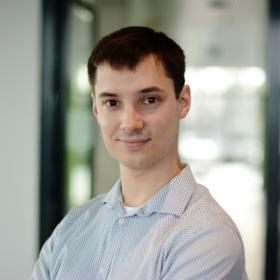
Toon Goedemé studied electrical engineering at KU Leuven. He received the Ph.D. degree in vision-based topological navigation from KU Leuven, in December 2006, under the guidance of Prof. L. Van Gool and T. Tuytelaars. Afterwards, he started teaching at the Technical University De Nayer, Sint-Katelijne-Waver, where he founded his research group Embedded and Artificially Intelligent Vision Engineering (EAVISE), in 2008. Nowadays, his group is integrated in the KU Leuven and consists of three professors (Joost Vennekens, Patrick Vandewalle, and himself), four postdocs and about 20 researchers, playing a vital role in the transfer of computer vision and AI know-how from academic research towards the industry. Since 2014, he has been an Associate Professor with KU Leuven. He is the (co)author of more than 190 international publications and was a project leader of more than 75 industrially co-founded research projects. Together with his team, he won several awards, such as the Best Paper Award at Embedded Vision Workshop CVPR 2015, the Best Demo Award at BNAIC 2015, the Best Paper Award at CGVCVIP 2016, the Willy Asselman Award for research achievements in 2016, and the Best Paper Award at Embedded Vision Workshop ECCV 2020. He is also an Associate Editor of the IET Computer Vision journal and the MDPI Journal of Imaging.

Peter Karsmakers
Dr. Peter Karsmakers behaalde het M.Sc. diploma in artificiële intelligentie in 2004 en het PhD diploma aan het departement Electrical Engineering, KU Leuven, in 2010. Van 2010 tot 2013 was hij postdoctoraal onderzoeker in het MOBILAB-onderzoeksteam van Thomas More. Van 2013 tot 2018 werkte hij als postdoctoraal onderzoeker aan de KU Leuven waar hij het ADVISE onderzoeksteam mee oprichtte. Momenteel is hij een Associate Professor binnen het departement Computerwetenschappen in de afdeling DTAI aan de KU Leuven en is hij lid van het Leuven.AI instituut. Sinds 2022 is hij PI van Flanders Make@KU Leuven. Zijn onderzoeksinteresses omvatten het ontwerpen van machine learning algorithm die rekening houden met toepassingsspecifieke beperkingen. Deze kunnen bijvoorbeeld betrekking hebben op het computerplatform waarop het machine learning algorithm zal worden ingezet, aan de behoefte van fysieke consistentie tussen modelvariabelen, aan het gebrek aan data annotatie of aan andere toepassingsgerelateerde specificaties. Hij werkte aan diverse projecten, meestal in samenwerking met industriële partners, waarbij zowel mensen als machines worden bewaakt met behulp van sensoren zoals microfoons, versnellingsmeters en radars.
